A few years ago, I spent time helping a small business owner set up a backup internet connection after his local provider kept going down during work hours. He ran an online export business, and every outage meant delayed payments, missed calls, angry clients, and lost trust.
At first, I thought internet problems were just annoying inconveniences. After watching that business struggle for months, I realized something bigger:
A country’s internet quality directly affects its economy.
Not in a vague “technology is important” kind of way. I mean real money, real jobs, real productivity.
When people can reliably connect to the internet, businesses grow faster, students learn better, freelancers earn globally, and governments become more efficient. When the internet is weak, everything slows down — even if people are talented and motivated.
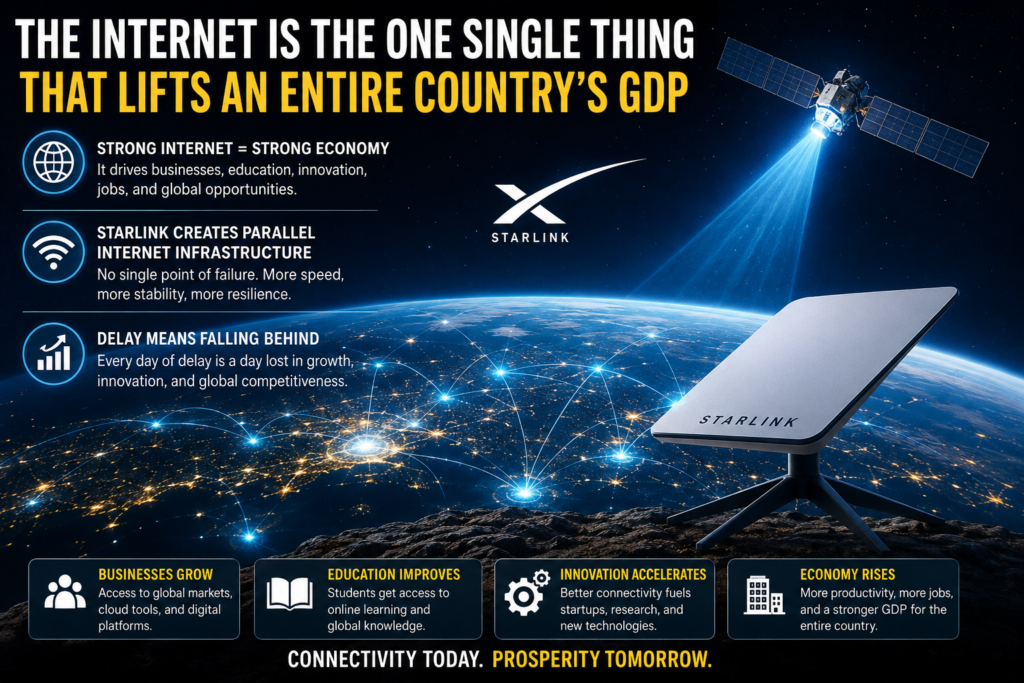
That’s why projects like Starlink are getting so much attention worldwide. For many countries, this isn’t just about faster Netflix streaming. It’s about building a second digital backbone for the entire economy.
And honestly, countries that delay adapting to this shift may end up years behind.
I Didn’t Fully Understand Internet Infrastructure Until I Saw It Fail
Most people only think about internet speed when videos buffer or games lag.
But after working remotely for years and dealing with unstable networks in different regions, I started noticing how much of modern life depends on connectivity staying alive every single day.
Here’s what breaks when internet access becomes unreliable:
- Online businesses stop processing orders
- Schools lose access to digital learning
- Freelancers miss deadlines
- Hospitals struggle with cloud systems
- Banks experience transaction delays
- Remote workers disappear from meetings
- Government services slow down
Now multiply that across millions of people.
That’s not just a technical issue anymore. That becomes a GDP issue.
Countries don’t grow economically just because they have resources. They grow because people can work efficiently, communicate globally, and access modern tools without constant friction.
Reliable internet removes friction.
Why Internet Access Is Basically Economic Infrastructure Now
For decades, countries invested heavily in roads, ports, railways, and electricity grids because those systems moved economies forward.
Today, internet infrastructure belongs in that same category.
Think about how many industries now depend on connectivity:
- E-commerce
- Banking
- Software development
- Logistics
- Digital marketing
- Remote customer support
- Online education
- Streaming media
- AI tools
- Cloud computing
Even farming is becoming internet-driven through smart irrigation systems and satellite monitoring.
A weak internet network in 2026 is similar to having unreliable electricity in the 1990s. Businesses can survive, but growth becomes painfully slow.
That’s one reason countries are racing to expand fiber networks, 5G, and satellite internet systems.
What Makes Starlink Different
Traditional internet infrastructure usually depends on underground fiber cables, telecom towers, and regional ISPs.
That system works well in major cities. But rural areas, mountains, deserts, islands, and developing regions often get ignored because building infrastructure there is expensive.
That’s where SpaceX changed the conversation with Starlink.
Instead of depending entirely on ground infrastructure, Starlink uses low-Earth orbit satellites to deliver internet access almost anywhere with a clear sky view.
The first time I tested satellite internet at a remote location, I expected terrible speeds and huge delays. That used to be normal with older satellite systems.
But modern low-orbit satellite internet feels surprisingly usable for everyday work:
- Video calls
- Cloud uploads
- Remote work
- Streaming
- Online gaming
- File transfers
It’s not perfect, and weather can still affect performance sometimes, but the difference compared to older satellite systems is massive.
For countries with weak telecom infrastructure, this becomes incredibly important.
Because now they can add a parallel internet layer without waiting 10–15 years for nationwide fiber rollout.
The “Parallel Infrastructure” Idea Is Bigger Than People Realize
This part gets overlooked a lot.
When a country adopts satellite internet at scale, it’s not simply adding another ISP.
It’s creating redundancy.
And redundancy is what keeps economies running during crises.
Imagine:
- A major cable outage
- Political instability
- Natural disasters
- Flood damage
- Power grid failures
- Regional telecom shutdowns
If the entire country relies on one fragile system, economic activity freezes.
But parallel internet infrastructure creates resilience.
That matters more than most people think.
I’ve seen small businesses lose entire workdays because one local provider went down. Now imagine that happening nationwide during an emergency.
Countries with backup digital infrastructure recover faster.
And faster recovery protects GDP.
Why Delaying Internet Expansion Is Riskier Than Ever
One mistake some governments make is treating advanced internet infrastructure like a luxury upgrade instead of an economic necessity.
That delay compounds over time.
Here’s why.
1. Remote Work Is Now Global Competition
A designer in Pakistan, a developer in Kenya, and a marketer in Brazil can all compete for the same online jobs.
But stable internet decides who actually gets hired consistently.
Clients care about reliability. If calls freeze or uploads fail constantly, opportunities disappear.
Countries with poor connectivity unintentionally handicap their own workforce.
2. AI and Cloud Tools Depend on Strong Internet
Modern businesses increasingly rely on:
- Cloud storage
- AI assistants
- SaaS platforms
- Real-time collaboration
- Online automation tools
Weak infrastructure slows adoption.
That means businesses in poorly connected countries often operate less efficiently than global competitors.
3. Investors Watch Infrastructure Closely
International companies notice digital reliability.
A region with unstable internet becomes less attractive for:
- Tech startups
- Outsourcing firms
- Remote operations
- Data services
- E-commerce expansion
Reliable internet lowers operational risk.
That attracts investment.
A Real Problem Most People Don’t Notice
One thing I learned while working online is that people in major cities often underestimate how disconnected rural communities still are.
In some areas:
- Mobile data is unstable
- Speeds collapse during peak hours
- Power outages interrupt service
- Fiber access barely exists
Students struggle to watch educational content.
Freelancers travel long distances just to upload files.
Small businesses avoid digital tools because connections are unreliable.
That creates a hidden economic divide inside countries.
Satellite internet doesn’t magically solve every problem, but it can dramatically reduce the gap between urban and remote areas.
And when more people can participate in the digital economy, the entire country benefits.
Common Mistakes Countries Make With Internet Policy
After following telecom development for years, I keep seeing the same mistakes repeated.
Treating Internet Like Entertainment Only
Internet access is no longer just social media and streaming.
It’s business infrastructure.
Policies built around outdated assumptions slow economic progress.
Over-Regulating Innovation
Some governments delay new technologies because they want total control first.
That hesitation can backfire.
While approvals stall, neighboring countries move faster and attract digital businesses.
Ignoring Rural Areas
Focusing only on major cities creates long-term inequality.
Eventually, rural regions fall behind economically, educationally, and technologically.
Depending On One System
Single-provider dependency is dangerous.
Redundant infrastructure improves national resilience.
What Countries Should Actually Focus On
From what I’ve seen, the smartest strategy isn’t choosing one internet technology over another.
It’s combining multiple systems together.
A stronger national internet strategy usually includes:
- Fiber networks in cities
- 5G expansion
- Satellite internet coverage
- Local data centers
- Better power infrastructure
- Affordable access programs
No single solution fixes everything.
But countries that aggressively expand connectivity tend to move faster economically.
The Surprising Impact On Everyday People
This topic sounds massive and geopolitical, but it affects ordinary people more than they realize.
Better internet means:
- More remote job opportunities
- Faster online businesses
- Better education access
- Easier digital payments
- Improved telemedicine
- Lower communication costs
- More global competition access
I’ve personally seen people go from local-only income to international clients simply because they finally got stable high-speed internet.
That transformation is becoming increasingly common.
The Gap Between Connected And Disconnected Countries Will Grow
Here’s the uncomfortable reality.
The digital divide between countries is no longer just about technology access. It’s becoming an economic multiplier.
Countries with strong internet infrastructure:
- attract investment faster,
- train digital workers faster,
- adopt AI tools faster,
- build startups faster,
- and recover from disruptions faster.
Countries that delay modernization may find themselves permanently catching up.
And the scary part is that the gap compounds quietly over time.
A one-year delay becomes a five-year disadvantage surprisingly fast when the rest of the world keeps accelerating.
Final Thoughts
I used to think internet discussions were mostly about convenience and entertainment.
Now I see connectivity as one of the most important economic tools a country can invest in.
The countries building resilient, fast, and widely available internet systems today are preparing their populations for the next generation of global work and business.